ESMAP Monthly E-Bulletin July 2012 Issue
|
A Bridge to a Sustainable Energy Future
ESMAP E-BULLETIN July 2012 Issue |
|
PROGRAM HIGHLIGHTS |
|
The global Sustainable Energy for All initiative calls for concerted action to achieve universal energy access, a doubling of the share of world energy supplied by renewable sources, and a doubling in the rate of improvement in energy efficiency – all by 2030. The World Bank declared its support for the initiative at the Rio+20 conference, with a number of the key inputs of this support coming from ESMAP. These inputs include scaled up support for energy efficiency in cities, mapping of renewable energy resources, and new initiatives to support development of geothermal power generation. ESMAP will also work together with the World Bank’s energy unit and a consortium of international agencies to produce a report that will mark the baseline for progress towards the three Sustainable Energy for All goals.
Read the press release. More information on the World Bank’s support for Sustainable Energy for All.
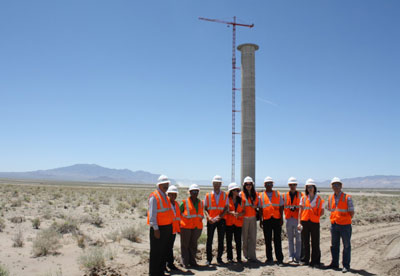
Following a request from the South African utility Eskom to the World Bank, ESMAP organized a special session on concentrated solar power (CSP) at the World Renewable Energy Forum (WREF) in May 2012. Practitioners were invited from South Africa, Morocco, India and Mexico – countries where the World Bank is involved in helping plan or support the scale up of CSP. Following the session, the experts visited CSP facilities now under construction or starting operations in the southwestern United States, to get a better understanding of the most appropriate new CSP technologies for their countries. Learn more.
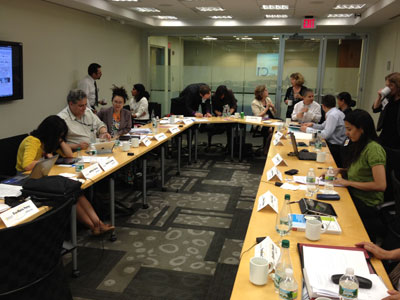
The selection of electricity technology is critical for designing new power generation projects, but these choices are increasingly complex, due to the pace of technological change, rapid shifts in equipment and fuel prices, and the challenge of reducing carbon emissions. To help electricity policy-makers and planners, ESMAP has developed the Model for Electricity Technology Assessment (META), which provides a comparative assessment of the levelized costs for a range of electricity supply options, including renewable energy. The model takes into account changes in capital and operating costs over time, environmental externalities, and transmission and distribution options. META was launched at a workshop at the World Bank in Washington on June 12. Learn more.
How can the public sector be harnessed to shape the market for energy efficient goods and services? That was the main topic of debate at a practitioners’ workshop on public procurement of energy efficient products organized by ESMAP at the World Bank on June 7-8, 2012. Participants – representing ten countries, six international energy efficiency organizations and two municipalities – shared their experiences and challenges in developing policies and programs that ensure that public agencies purchase energy efficient equipment. Such programs are important as energy efficient products offer a better value for governments than traditional equipment which costs more to operate over a lifetime. Learn more.
Security of supply in energy markets is an increasing matter of concern for governments and energy regulators. Energy reforms have led to a more efficient power sector, but also to greater price volatility and increased commercial risk for new capacity investment across all fuel types. These issues were at the center of discussion at the Fifth World Forum on Energy Regulation (WFER), held in Québec, Canada on May 13-16. The forum brought together energy regulators, policymakers and practitioners – over 1,000 participants from 100 countries. As part of its support for knowledge exchange among client countries, ESMAP organized a session at WFER on regulation in developing markets, and sponsored the participation of officials from Brazil, Guatemala and South Africa, as well as from the African Forum for Utility Regulators. The issue of security of supply was also addressed at a plenary session by Maria Vagliasindi, Lead Economist of the World Bank’s Sustainable Energy Department. Learn more.
Mapping national renewable energy resources is a crucial step in providing the information needed for governments to support the sustainable expansion of renewable power generation. ESMAP is currently preparing a new business line to support country-level resource mapping for biomass, small hydro, solar and wind. Funding would be available for ground-based measurement campaigns, data analysis, GIS mapping, strategic environmental assessment, and policy integration. By working closely with the International Renewable Energy Agency (IRENA) and the Clean Energy Ministerial (CEM) Working Group on Solar and Wind, ESMAP also hopes to contribute to international efforts to improve the availability of global datasets on renewable energy resources. Learn more. |
|
PUBLICATIONS
|
|
Peer-Reviewed Papers Supported by ESMAP
|
|
The Energy Sector Management Assistance Program (ESMAP) is a global knowledge and technical assistance partnership administered by the World Bank and funded by Australia, Austria, Denmark, Finland, France, Germany, Iceland, Lithuania, the Netherlands, Norway, Sweden, and the United Kingdom, as well as the World Bank.
ESMAP's mission is to assist clients—-low and middle income countries—-to increase know-how and institutional capacity to achieve environmentally sustainable energy solutions for poverty reduction and economic growth.For more information about the Energy Sector Management Assistance Program, please visit www.esmap.org.
Read all E-Bulletins |
Banner Photo Credits: stock.xchng (left and right); Jamie Seno / Lighting Africa / World Bank (center)