Publications
Executive Summary
| Available in: | English | Spanish | |
| Coming soon: | French | Arabic | Japanese |
For emerging markets and developing economies, hydrogen offers a strategic opportunity to convert abundant renewable resources into industrial transformation, energy security, and job creation. Yet scaling clean hydrogen presents significant challenges, particularly given the capital intensity, technical complexity, and financial risks of early-stage deployment. At the center of this transition are electrolyzers—the core technology that uses renewable electricity to split water into hydrogen and oxygen—enabling decarbonization in hard-to-abate sectors such as chemicals, steel, shipping, and heavy transport.
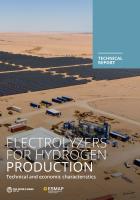
The new report, Electrolyzers for Hydrogen Production: Technical and Economic Characteristics, produced by the World Bank Group’s Energy Sector Management Assistance Program (ESMAP) under the 10 GW Lighthouse Initiative, provides the first comprehensive global assessment of electrolyzer technologies and their role in scaling renewable hydrogen. Drawing on engagement with more than 50 manufacturers, developers, financiers, and market experts, it offers practical insights into technology trends, cost structures, supply chains, commercial models, and risk allocation.
The report highlights that while global electrolyzer manufacturing capacity has expanded rapidly, the market remains uneven, with overcapacity and low plant utilization in some regions. Alkaline technology continues to dominate, though PEM and emerging technologies are gaining ground. Soft costs—such as engineering, procurement, construction, and financing—often outweigh stack costs, while electricity prices remain the decisive driver of hydrogen competitiveness.
Designed as a decision-oriented reference, the report supports governments, investors, and developers in making informed, bankable choices to accelerate large-scale green hydrogen deployment, particularly in emerging markets.
Explore | Why do electrolyzers matter?
Learn more about World Bank Group's 10 GW Lighthouse Initiative
Energy Sector Management Assistance Program (ESMAP). 2026.
Electrolyzers for Hydrogen Production Technical and Economic Characteristics. ESMAP Technical Report. Washington, DC: World Bank.