Key barriers are systemic—not technical: Utility‑scale solar deployment in low‑ and middle‑income countries is held back mainly by investment risks, weak institutions, and structural issues such as a lack of bankable projects, regulatory uncertainty, weak utilities as off‑takers, and limited grid and planning capacity.
High risk and weak infrastructure deter investors: Political and regulatory uncertainty, currency and enforcement risks, financially fragile state utilities, grid constraints, and complex procurement, land, and permitting processes all raise costs, delay projects, and limit private financing.
ESMAP supports a system‑wide solution: ESMAP helps countries move from one‑off projects to scalable solar programs by strengthening project preparation and de‑risking, improving utility creditworthiness and grid readiness, building regulatory and institutional capacity, and promoting transparent, competitive procurement to attract investment and lower costs.
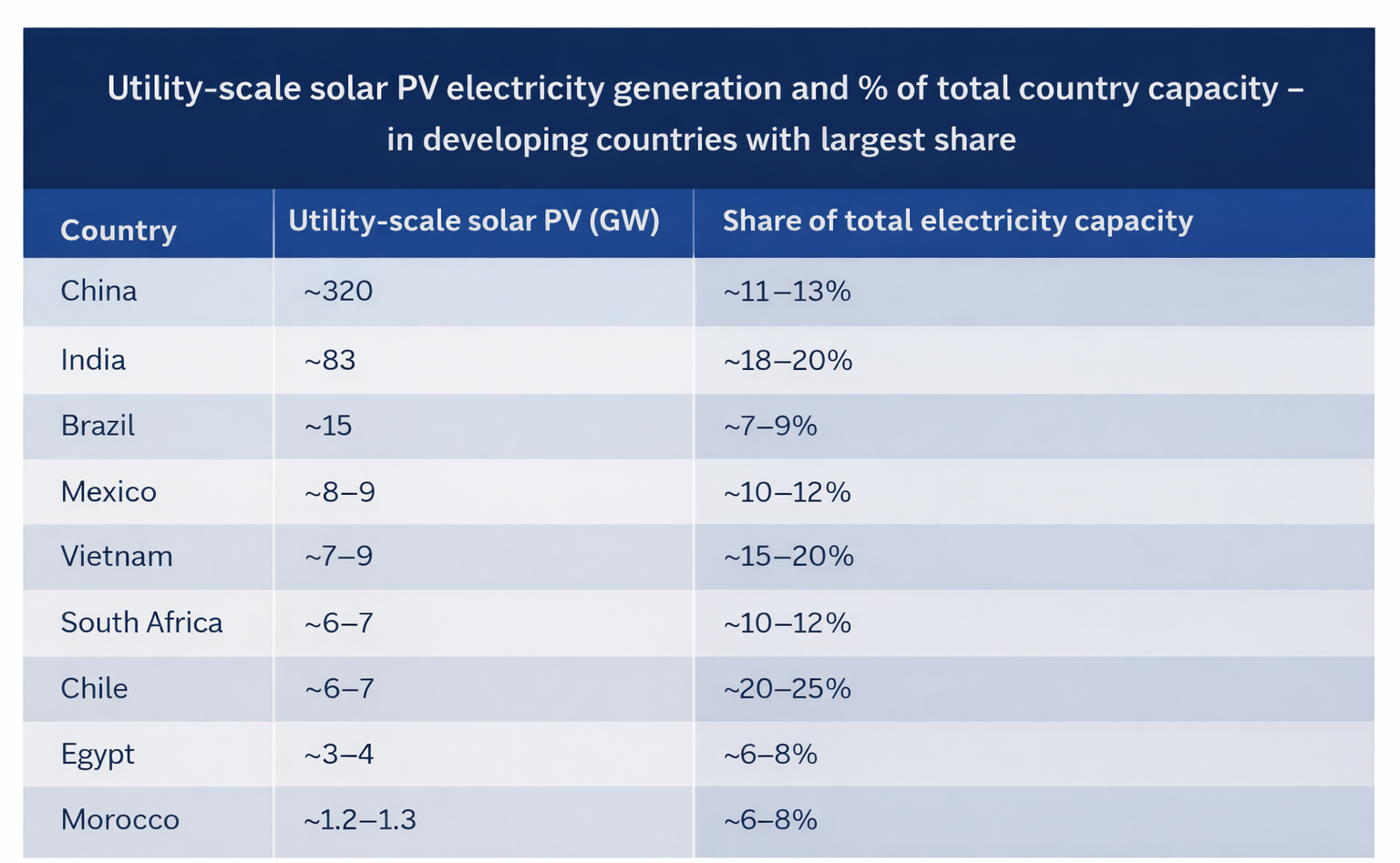
The main obstacles to deploying utility-scale solar in low- and middle-income countries are not related to technology or cost, but to systemic risks and structural weaknesses that discourage investment. A central challenge is the lack of a pipeline of bankable projects. Many projects are insufficiently prepared, poorly structured, or not adequately de-risked, making them unattractive to private investors even in countries where strong solar resources exist.
High perceived investment risk further limits deployment. Investors face political and regulatory uncertainty, currency volatility, and concerns about contract enforcement. These risks increase the cost of capital or prevent financing altogether. Weak off-takers—typically state-owned utilities—compound the issue, as their limited financial viability raises doubts about their ability to honor power purchasing agreements.
Infrastructure constraints are another major barrier. Weak transmission networks and limited grid capacity often prevent solar projects from connecting or operating efficiently. At the same time, many countries lack the planning tools and institutional capacity needed to integrate variable renewable energy at scale. Regulatory and institutional weaknesses, including unclear legal frameworks and limited administrative capacity, further slow project development. Procurement challenges—such as inconsistent tendering processes and limited experience in structuring contracts—add to delays and costs, while land acquisition and permitting issues increase complexity and risk.
Solutions and the Role of ESMAP
Unlocking the potential of utility-scale solar requires a comprehensive, system-wide approach focused on reducing risk and strengthening the enabling environment. ESMAP and the SRMI partnership [link] play a central role in supporting this transformation by helping countries move from isolated projects to scalable, sustainable solar programs.
A key priority is developing a consistent pipeline of bankable projects. ESMAP helps to improve project preparation, standardize documentation, and clarify risk allocation – all to make projects more attractive to private investors. It also promotes systematic de-risking through financial guarantees, blended finance, and other instruments that address political, financial, and currency-related risks, thereby lowering the cost of capital.
Strengthening utilities is another critical area. ESMAP works with governments to improve the financial health and credibility of state-owned utilities as off-takers, including the use of payment security mechanisms and broader sector reforms. At the same time, it supports investments in grid infrastructure and integrated system planning to ensure that solar projects can be connected and operated efficiently.
ESMAP also emphasizes the importance of clear regulatory frameworks and strong institutions. By providing technical assistance and capacity building, it helps governments design transparent policies and manage projects effectively. In addition, ESMAP promotes competitive procurement mechanisms, such as auctions and tenders, which have proven effective in reducing costs and attracting investment.