
By Chandra Govindarajalu, Practice Manager, ESMAP
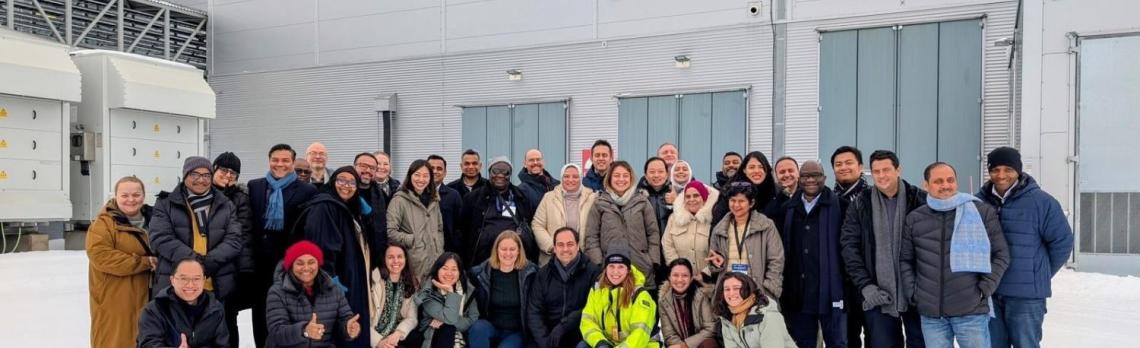
Amid snow-covered landscapes and Arctic winter skies, government and industry leaders from ten countries1 spent an inspiring week in Sweden and Norway seeing industrial decarbonization in action at some of the world’s most advanced low-carbon industrial plants.
Heavy industry sectors such as steel, cement, and chemicals account for around 70 percent of industrial emissions. Decarbonizing heavy industry presents a real economic opportunity for emerging markets and developing economies. Electrifying machinery, utilizing renewable energy, and implementing hydrogen technology can lead to strengthened energy security and jobs creation. Industrial decarbonization is most effective when anchored in strong, predictable policy frameworks, such as carbon pricing, net-zero targets, and aligned standards, that provide the clarity needed for long-term investment decisions.
The Industrial Decarbonization study tour was co-organized by World Bank Group’s ESMAP, LeadIT, the Government of Sweden, and SIDA to exchange practical lessons on how smart policy, targeted finance, and innovation can make low-carbon industry competitive today. Our goal was simple: we wanted participants to leave with the partnerships, tools, and confidence to accelerate decarbonization in their home countries.
Industrial Decarbonization Projects in Sweden and Norway
In Sweden and Norway, participants saw industrial decarbonization principles brought to life. From green steel to low-carbon cement, from hydrogen hubs to state-of-the-art Carbon Capture and Storage (CCS) infrastructure.
Helena Dyrssen, State Secretary in Sweden’s Ministry of Climate and Enterprise
|
At Stegra (formerly H2 Green Steel), participants stood on the construction site of what will soon be Europe’s first integrated, largescale green steel plant—powered by electrolysis, hydrogen-based direct reduction, and renewable electricity. Once commissioned, the plant aims to produce up to 5 million tonnes of near-zero emission steel, cutting emissions by 95% compared to traditional blast furnaces.
At HYBRIT, delegates explored the world’s first pilot for fossil free ironmaking that delivered the first batch of fossil free steel to Volvo in 2021. HYBRIT’s success demonstrates what becomes possible when long-term policy support and cross-sector collaboration converge.
At CH2ESS, a research and knowledge initiative hosted by Luleå University of Technology, participants engaged with researchers developing innovation and pilot initiatives for hydrogen solutions in industrial processes and energy systems.
In LKAB’s Kiruna mine, one of the world’s largest underground mining operations, delegates were taken 500 meters below ground to see how fossil-free mining and critical mineral development are shaping northern Sweden’s future. The visit underscored a key theme: industrial transformation must go hand in hand with community development, local engagement, and economic diversification.
In Norway, participants visited the Heidelberg Materials cement plant in Brevik, the world’s first industrial scale CCS project in the cement sector. Operational since 2025, the facility captures 400,000 tons of CO₂ annually, forming part of Norway’s Longship CCS value chain.
At the Yara plant in Herøya, delegates toured one of Europe’s largest renewable hydrogen and ammonia facilities, a flagship example of how legacy chemical hubs can be retrofitted for a net-zero future.
Insights from Participating Countries
Across the visit, participants observed that long-term policy certainty remains the foundation for investment, with political leadership and predictable frameworks giving companies the confidence to commit capital. The absence of sector-specific targets, roadmaps, and standardized definitions for green products continues to limit investment and slows the development of low-carbon markets.
Carbon pricing and demand creation tools such as green procurement, contracts for difference, and credible certification were repeatedly highlighted as essential levers for scaling markets for low-carbon materials. Participants also saw how financing structures must evolve to blend capital types and distribute risk more equitably. Public–private partnerships, early-stage derisking, and innovative financial instruments were common features across successful initiatives.
Nyakallo Angela Dlambulo, Director of Ferrous Metals, The Department of Trade, Industry and Competition, South Africa
|
Equally important was the recognition that the decarbonization of industries cannot outpace infrastructure readiness. The growth of industries running on clean energies must be aligned with the integration of renewable energy in the grids, hydrogen networks, and CO₂ transport and storage corridors that enable it. Delegates also saw that coordination between producers, off-takers, financiers, and regulators enables joint planning which can unlock both cost savings and competitiveness. A just and inclusive transition emerged as another nonnegotiable element, with community benefits, local employment, and transparent engagement cited as markers of durable progress.
Brazil’s Francisco Paiva Avelino, Director of Decarbonization & Green Finance, Ministry of Industry, Brazil
|
Finally, the visit underscored the value of capacity building and international collaboration; participants learned as much from peer countries as they did from the Swedish and Norwegian examples, reinforcing that global cooperation accelerates solutions for everyone.
Sara Naguib, General Manager, Energy Efficiency & Climate Department, Ministry of Petroleum & Mineral Resources, Egypt
|
1Brazil, Mexico, India, South Africa, Namibia, Indonesia, Philippines, Egypt, Türkiye and Viet Nam