Publications
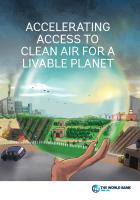
Outdoor air pollution poses health and economic challenges across all regions in the world. Ninety nine percent of people worldwide are exposed to unhealthy levels of pollution, with some of the most damaging impacts in low- and middle-income countries. Curbing air pollution is already a crucial development challenge today and will be even more imperative for future growth and prosperity.
However, substantial improvement is possible. Halving the number of people exposed to high levels of outdoor air pollution globally by 2040 can be both feasible and affordable. As air pollution mostly comes from manmade sources, effective policies can bring it down. Heating, cooking, transport, agriculture, and waste are sectors key to making progress, and require an integrated approach. Quick-win priorities are apparent: solid fuel heating is a major issue in low- and middle-income countries, whereas residential cooking is a primary concern in much of Africa. While these specific priorities will depend on country and regional context, any successful policies and measures will hinge on three actions: i) strengthening institutions; ii) leveraging information, and iii) catalyzing investments.
To learn more about Accelerating Access to Clean Air.
World Bank.
Accelerating Access to Clean Air for a Livable Planet (English). Washington, D.C. : World Bank Group. http://documents.worldbank.org/curated/en/099032625132535486