
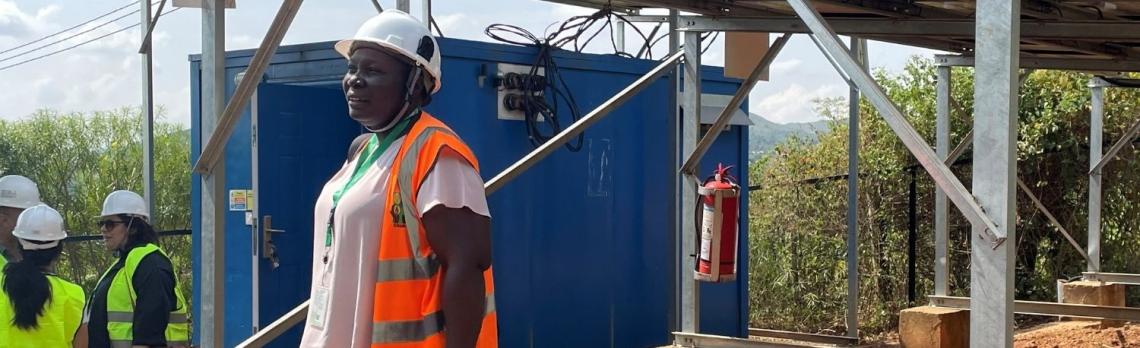
How Women Are Navigating—and Shaping—Safer Energy Projects1
By Fanny Missfeldt-Ringius, Samantha Constant and Ursula Casabonne
Story Highlights
Women in the energy sector face risks of gender-based violence both as workers—due to inadequate workplace policies and lack of safe facilities—and as consumers, where unreliable or poorly designed infrastructure exposes them to harm while accessing essential services.
The Energy Sector Management Assistance Program (ESMAP) has published an Energy Brief identifying key risks and proposing targeted interventions—such as safer infrastructure, workplace reforms, and community safeguards—to prevent violence against women and girls and strengthen support systems.
Action and results in Ethiopia and the Democratic Republic of Congo demonstrate progress: Ethiopia’s Electric Utility has implemented comprehensive anti-harassment policies and grievance mechanisms, while the Inga 3 Development Program in DRC invests in survivor-centered services, psychosocial support, and economic empowerment initiatives.
As dawn breaks over a long stretch of electricity pylons cutting through the countryside, Nadia fastens her harness, mentally preparing for another day repairing transmission lines. Her pride in trailblazing as one of the few women entrusted with field assignments is matched only by the unique pressures she faces—pressures rarely noticed by her male colleagues. The field camps where Nadia stays overnight offer no separate sleeping quarters and little privacy in water and sanitation facilities. While safety protocols exist, they were designed without women in mind. Often, she is the only woman among ever-changing teams of male contractors, leaving her hesitant to voice discomfort or request different accommodations. Every assignment is a delicate calculation: how much she can ask for, how much she must endure, and how she can remain safe while simply doing her job.
For Lucía, the challenges are woven into the fabric of daily life. Each evening, she hurries along a narrow, unlit footpath to the community charging kiosk—the only place to power the lamp her children need for their studies. When outages strike, the village is plunged into darkness, amplifying the risks along her route. Whispers of harassment near the kiosk and in the shadows are common among women in her community, but the location of the charging station was chosen without consulting those it most effects. For Lucía, a simple trip to secure energy becomes a nightly negotiation, weighing how fast she can walk, who might be nearby, and whether her children’s learning is worth the risk.
Invisible Risks, Tangible Realities
The experiences of Nadia and Lucía reflect widespread patterns in the energy sector, where women and girls encounter gender-based violence (GBV) risks in both the workplace and the community. According to the World Health Organization, almost one in three women worldwide—around 840 million—have experienced physical and/or sexual violence in their lifetime. These numbers, underreported and understated, fail to capture the full scope of the problem, especially in sectors like energy, where gender norms and structural barriers dictate who benefit from access, employment, and infrastructure.
Where Energy and Gender-Based Violence Intersect
To help address this challenge, the Energy Sector Management Assistance Program (ESMAP) published an Energy Brief to identify risks and practical measures that go beyond mitigating risks through safeguards to prevent violence against women and girls (VAWG) as well as strengthen response systems and services.
The risks women face in energy projects emerge through three main pathways:
As consumers: Women are exposed to harm when energy is unreliable or unaffordable—from walking long distances for fuel to moving through unlit public spaces.
As workers: The male-dominated sector often lacks robust anti-harassment policies, confidential complaint channels, and trained supervisors. Women may face backlash for increased income, triggering domestic violence or social sanctions.
In project communities: Large-scale operations can disrupt local dynamics, escalating risks of sexual exploitation, abuse, and harassment—especially when oversight is weak, and grievance mechanisms are inadequate.
Solutions Taking Shape: Lighting the Way Forward
The struggles of women like Nadia and Lucía have sparked a movement toward solutions that can truly transform energy projects into platforms for women’s safety and empowerment. When designing a project, targeted interventions can be proposed to make a difference well after its completion:
Infrastructure and service design: Building safe, gender-responsive facilities, ensuring tariff and subsidy reforms consider household stress and VAWG risks, and requiring utilities to adopt harassment-free customer service protocols.
Workplace changes: Enforcing anti-harassment policies, integrating prevention into occupational safety and labor inspection systems, providing secure facilities, and establishing confidential reporting channels.
Community safeguards: Implementing measures to address labor influx and construction risks, establishing accessible grievance redress mechanisms, and supporting awareness campaigns and digital safety to prevent backlash.
Results in Ethiopia and DRC
In the Africa region where the World Bank Group is supporting countries to meet their M300 ambition, teams can draw from the Energy Brief to ensure project interventions respond meaningfully to the different risks women face across the different pathways. Such approaches are already yielding results in places like Ethiopia, where the Electric Utility (EEU) introduced comprehensive sexual harassment policies, formal grievance mechanisms, and management accountability for gender-based violence.
“At EEU, our commitment to addressing GBV is not just about protecting individuals, it is about safeguarding dignity, strengthening communities, and ensuring that every workplace is a safe space where people can thrive,” says Ms. Meazagenet Tsegaye, Director of Women and Children's Affairs Department, Ethiopian Electric Utility, “Ending GBV is essential to building an equitable, resilient, and sustainable future.”
In the nearby Democratic Republic of Congo, the Inga 3 Development Program dedicated substantial resources to survivor-centered services, psychosocial support, and institutional reforms, showing that even in challenging environments, change is possible. Additionally, the project’s planned activities include support for socio-economic reintegration and empowerment through income-generating activities. This demonstrates how response can go even beyond protection services to also support livelihoods and build economic resilience for GBV survivors.
1The following scenarios are fictional but inspired by available evidence of what occurs in real life.