Publications
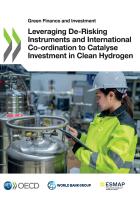
Clean hydrogen is a nascent technology that could play an essential role to achieve net-zero emissions. However, less than 10% of announced clean hydrogen projects worldwide have reached final investment decision, as equity and debt investors often consider these projects to be too risky. This report provides a better understanding of the risk mitigation strategies to unlock and mobilize private capital for clean hydrogen in emerging markets. It highlights how de-risking instruments can address key barriers faced by investors in clean hydrogen projects and suggests ways to allocate risks among actors. The report also proposes actions to enhance international co-ordination for scaling clean hydrogen financing for development. Furthermore, it draws lessons from case studies showcasing how lighthouse clean hydrogen projects and available economic, de-risking and financing instruments are being implemented in a wide array of countries.
This report was developed by the OECD Environment Directorate and the Energy Sector Management Assistance Program (ESMAP) of the World Bank’s Energy and Extractives (EEX) Global Practice.
WATCH THE WEBINAR
OECD/The World Bank. (2024). Leveraging De-Risking Instruments and International Co-ordination to Catalyse Investment in Clean Hydrogen, Green Finance and Investment. Paris: OECD Publishing, https://doi.org/10.1787/9a377303-en.