Publications
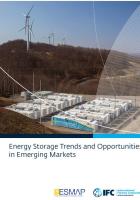
Energy storage is a crucial tool for enabling the effective integration of renewable energy and unlocking the benefits of local generation and a clean, resilient energy supply. The technology continues to prove its value to grid operators around the world who must manage the variable generation of solar and wind energy. However, the development of advanced energy storage systems (ESS) has been highly concentrated in select markets, primarily in regions with highly developed economies. Despite rapidly falling costs, ESSs remain expensive, and the significant upfront investment required is difficult to overcome without government support and/or low-cost financing. This type of advanced technology requires significant knowledge and expertise to be developed and operated cost-effectively. Furthermore, the services provided by ESS systems are often not properly valued or recognized within existing energy market regulations. Even with these barriers, installations of stationary ESSs are increasing dramatically around the world as system costs are rapidly decreasing and as energy markets are being reformed to allow for the use of more distributed resources.
The International Energy Agency (IEA) estimates that by 2020, developing countries will need to double their electrical power output to meet rising demand. It is estimated that by 2035, these nations will represent 80 percent of the total growth in both energy production and consumption. To meet worldwide goals for reduction of greenhouse-gas emissions, a substantial portion of this new generation capacity will likely come from renewable sources. While the costs for renewable generation continue to fall, integrating and effectively using these new resources, especially in regions with weak grid infrastructure, will require energy storage. Furthermore, emerging economies must bring reliable electricity service to about 1.2 billion people who currently lack access. Experience over the past several decades has shown that the traditional, centralized grid cannot or will not cost-effectively provide even basic electrical service to underserved populations in a reasonable amount of time. Distributed and remote power systems have enormous potential to provide service around the world but are subject to a number of barriers.
Energy storage deployments in emerging markets worldwide are expected to grow over 40 percent annually in the coming decade, adding approximately 80 GW of new storage capacity to the estimated 2 GW existing today. This report provides an overview of energy storage developments in emerging markets along with details on the services ESSs provide at the utility-scale, in buildings, and in remote power systems. Key trends and barriers for the technology in emerging markets are also be explored in depth. Finally, case studies are included to highlight successful projects around the world that demonstrate both the challenges and potential for energy storage in emerging markets.
Eller,Alex; Gauntlett,Dexter.Energy Storage Trends and Opportunities in Emerging Markets (English). Energy Sector Management Assistance Program (ESMAP) Washington, D.C. : World Bank Group. http://documents.worldbank.org/curated/en/388571595918184440/Energy-Storage-Trends-and-Opportunities-in-Emerging-Markets