Publications
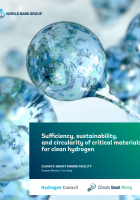
Effective global decarbonization will require an array of solutions across a portfolio of low-carbon resources. One such solution is developing clean hydrogen. This unique fuel has the potential to minimize climate change impacts, helping decarbonize hard-to-abate sectors such as heavy industry and global transport, while also promoting energy security, sustainable growth, and job creation. The authors estimate suggest that hydrogen needs to grow seven-fold to support the global energy transition, eventually accounting for ten percent of total energy consumption by 2050. A scaleup of this magnitude will increase demand for materials, such as aluminum, copper, iridium, nickel, platinum, vanadium and zinc to support hydrogen technologies - renewable electricity technologies and the electrolyzers for renewable hydrogen, carbon storage for low-carbon hydrogen, or fuel cells using hydrogen to power transport.
This report, a joint product of the World Bank and the Hydrogen Council, examines these three critical areas. Using new data on the material intensities of key technologies, the report estimates the amount of critical minerals needed to scale clean hydrogen. In addition, it shows how incorporating sustainable practices and policies for mining and processing materials can help minimize environmental impacts. Key among these approaches is the use of recycled materials, innovations in design in order to reduce material intensities, and adoption of policies from the Climate Smart Mining (CSM) Framework to reduce impacts to greenhouse gas emissions and water footprint.
Moreira, Susana; Laing, Timothy James. 2022. Sufficiency, Sustainability, and Circularity of Critical Materials for Clean Hydrogen. © Washington, DC: World Bank. http://hdl.handle.net/10986/38413 License: CC BY 3.0 IGO.