Publications
As renewable hydrogen becomes central to decarbonizing hard-to-abate sectors, such as steel manufacturing or heavy transport, deployment in Emerging Markets and Developing Countries depends on obtaining timely environmental and social permits on the social acceptance of hydrogen production plants, often referred to as social license to operate. These are not peripheral tasks as they directly shape project bankability, investment readiness, and long-term project sustainability.
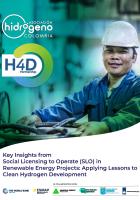
The World Bank’s report, Key Insights from Social Licensing to Operate in Renewable Energy Projects: Applying Lessons to Clean Hydrogen Development, underscores three interlinked challenges. First, unfamiliarity with hydrogen leads many national and local governments to regulate hydrogen as a hazardous substance rather than an energy carrier, resulting in overly cautious, fragmented permitting and inflated perceptions of environmental risk. Second, optimal renewable resource sites for hydrogen production (electrolyzers) are often located in ecologically sensitive or previously undeveloped landscapes, where environmental impact assessments lack robust baseline data and hydrogen-specific guidance—driving uncertainty, cost, and inconsistent permitting outcomes. Third, inadequate and late-stage stakeholder engagement can trigger community opposition—especially where benefit-sharing is weak and trust in safety, fairness, or local inclusion is low—causing delays or cancellations.
Drawing lessons from hydropower and wind, this paper argues that a successful social license to operate for clean hydrogen projects requires: early, continuous, and culturally informed engagement; credible benefit-sharing mechanisms and local value creation; transparent safety communication and emergency planning; streamlined, hydrogen-specific regulatory frameworks and consolidated permitting; and investment in baseline environmental and social data systems. Embedding these practices can de-risk projects, improve predictability, and align public interest with private investment, enabling renewable hydrogen to scale responsibly and equitably in emerging markets.
Energy Sector Management Assistance Program.
Key Insights from Social Licensing to Operate (SLO) in Renewable Energy Projects: Applying Lessons to Clean Hydrogen Development (English). ESMAP Paper. Washington, D.C. : World Bank Group. http://documents.worldbank.org/curated/en/099800109042522213