Publications
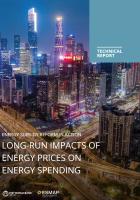
This analysis deploys the concept of national energy cost share, a practical indicator that measures the ratio of energy costs to gross domestic product (GDP), and uses a dataset covering 142 countries over a 40-year period. It examines how national energy cost shares evolve in response to changes in energy prices and economic activity, as well as the influence of energy efficiency policies and macroeconomic characteristics. Three types of analysis were performed: a descriptive overview of the historical patterns of energy prices and energy cost shares to explore how they change over the same period; an econometric estimation of the elasticity of energy cost shares with respect to economic output and energy prices; and an assessment of whether, and how, the response of energy cost shares to energy prices varies according to certain economy and energy efficiency policy characteristics.
Main findings and takeaways from the report include the following:
- Energy cost shares and energy prices tend to move together in the short run, but economies adapt to the impacts of energy price increases over time.
- On aggregate, the ability of economies to adjust to and absorb energy price increases has improved significantly over time, thanks to structural change, innovation, and efficiency.
- Some countries adapt faster, while others need more time to adapt; with major differences across countries due to macroeconomic, human capital, financial development, and energy sector characteristics.
- Although economies adapt over the long run, short-run impacts can be substantial, and the adjustment process is slow. Therefore, short-run mitigation measures, such as targeted compensation for low-income and vulnerable households, and support for response and adaptation by firms, are essential.
- Energy efficiency is crucial for managing the impact of price increases on cost shares and enhancing economies’ ability to adapt.
Learn more about ESMAP's Energy Subsidy Reform Facility.
Agnolucci, Paolo; Lipsis, Vincenzo De; Gencer, Defne; Lartey, Abraham; Grubb, Michael.
Long-Run Impacts of Energy Prices on Consumer Spending. Energy Subsidy Reform in Action Series - ESMAP Technical Report (English). Washington, D.C. : World Bank Group. Creative Commons Attribution CC BY 3.0 IGO. https://hdl.handle.net/10986/44127