














From Ambition to Action: Practical Insights on Energy Subsidy Reforms
Broad government energy subsidies are counterproductive: economically distortive, environmentally harmful, and fiscally inefficient. They divert funds from essential services while disproportionately benefiting wealthier households.
Reforming energy subsidies is necessary but challenging: They are politically risky and technically difficult to implement, often failing due to weak preparation, poor communication, and social resistance.
ESMAP recommends a comprehensive approach, including detailed sector analysis, multiple reform pathways, assessment of distributional impacts, and mitigation measures such as improved services or targeted support.
Effective reforms require strong government ownership, transparent communication, strategic timing, continuous evaluation, and alignment with broader fiscal, climate, and social policies to achieve lasting benefits and support low‑carbon development.
Governments spending vast amounts of taxpayer money to lower the cost of electricity, fossil fuels, or district heating is distortive and inefficient and therefore hampers development and the fight against climate change. While often intended to make energy affordable for low-income households, broad subsidies divert funding from priority areas such as health, education, social protection, and clean energy investment. Wealthier households disproportionately benefit from subsidies as they consume more energy.
Reforming (reducing or eliminating) energy subsidies is necessary but challenging due to political sensitivity, complex technical requirements, and the risk of social backlash. Many reforms have stalled, been reversed, or failed due to weak preparation and inadequate communication.
To guide sustainable reform, ESMAP’s Energy Subsidy Reform Assessment Framework (ESRAF) proposes a comprehensive approach grounded in detailed sector analysis, fiscal and macroeconomic assessment, poverty diagnostics, and understanding of political economy dynamics.
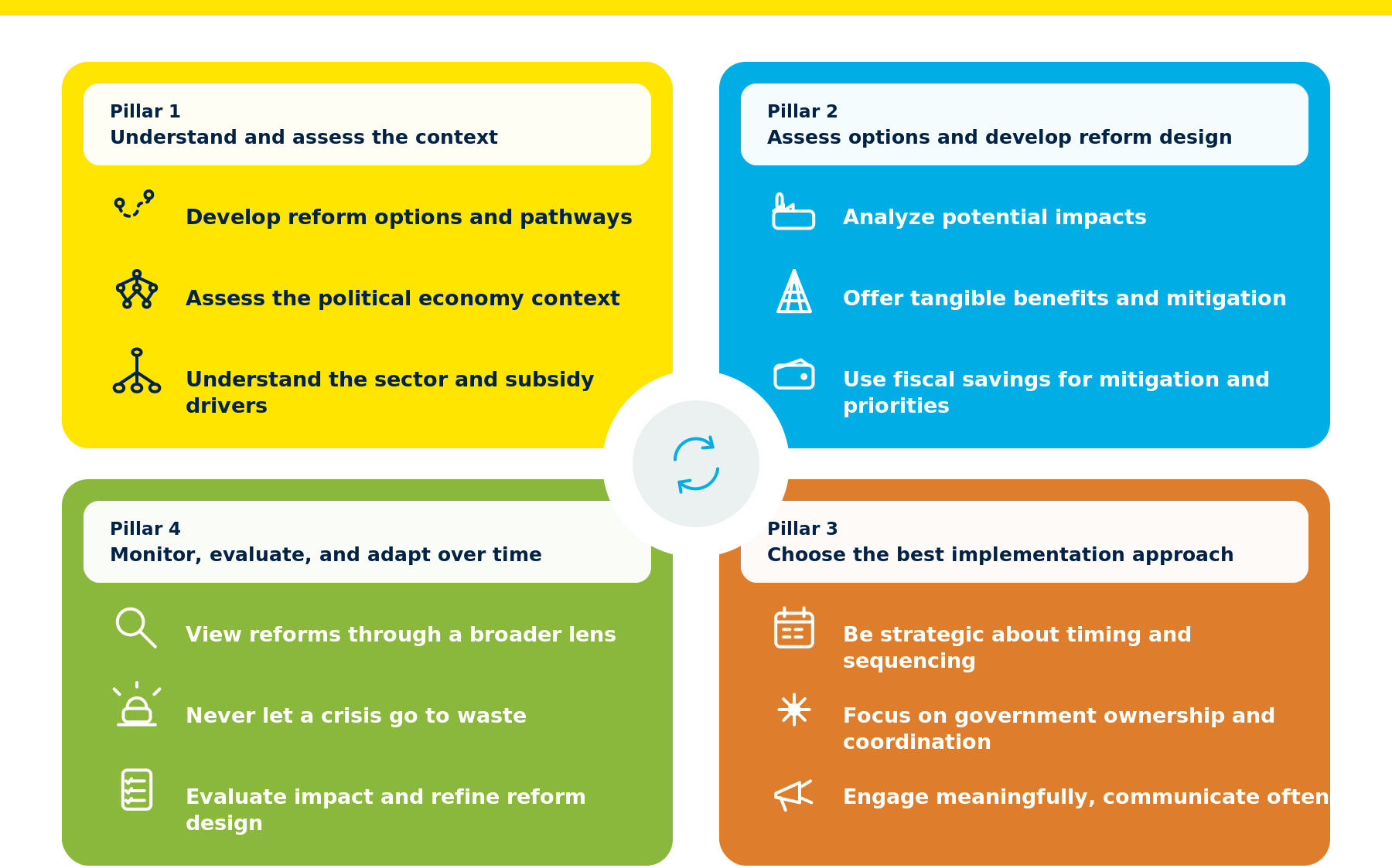
ESMAP’s 12 practical steps for reforming energy subsidies:
Gain a solid understanding of the motivation for and impacts of energy subsidies
Develop several reform options and alternative pathways.
Understand who will be affected, how, and to what extent.
Assess the political economy context.
Build mitigation measures into reform design and offer tangible benefits for society and the economy.
Channel fiscal savings from energy subsidy reforms towards mitigation measures and policy priorities.
Be strategic about timing and sequencing of reform and mitigation measures.
Encourage government ownership and coordination across relevant government agencies.
Engage meaningfully and communicate clearly and often
Evaluate the impact of reform measures and refine designs based on implementation experience
Never let a crisis go to waste and act fast when a reform opportunity presents itself.
View energy subsidy reforms through a broader reform lens.
Ultimately, carefully designed reforms can reduce wasteful spending, support the poor more effectively, and accelerate the transition to low‑carbon, efficient energy systems—demonstrated in countries such as Ukraine, the Dominican Republic, and Egypt.