










How to Unlock Pipelines of Bankable Renewable Energy Projects in Developing Countries?
- Delivering the energy transition will require a rapid scale-up of renewable energy, with both public and private finance playing essential roles. In emerging markets and developing economies, renewable capacity will need to triple by 2030, demanding a substantial increase in investment flows.
- The primary constraint is not a lack of capital, but a shortage of bankable projects. Even in challenging environments, well-structured tenders attract strong investor interest and mobilize private finance. Yet globally, the pipeline of bankable renewable energy projects remains insufficient.
- Building this pipeline requires coordinated government action to address country-specific risks and barriers, while advancing affordability and poverty reduction. With support from multilateral development banks and development partners, governments can reduce risks perceived by independent power producers, creating the conditions needed to scale renewable energy investment.
Achieving the global energy transition will require a dramatic expansion of renewable energy deployment, particularly in Emerging Markets and Developing Countries (EMDC). Meeting the Paris Agreement targets necessitates tripling renewable energy capacity in these countries by 2030, which in turn requires a significant increase in financing flows.
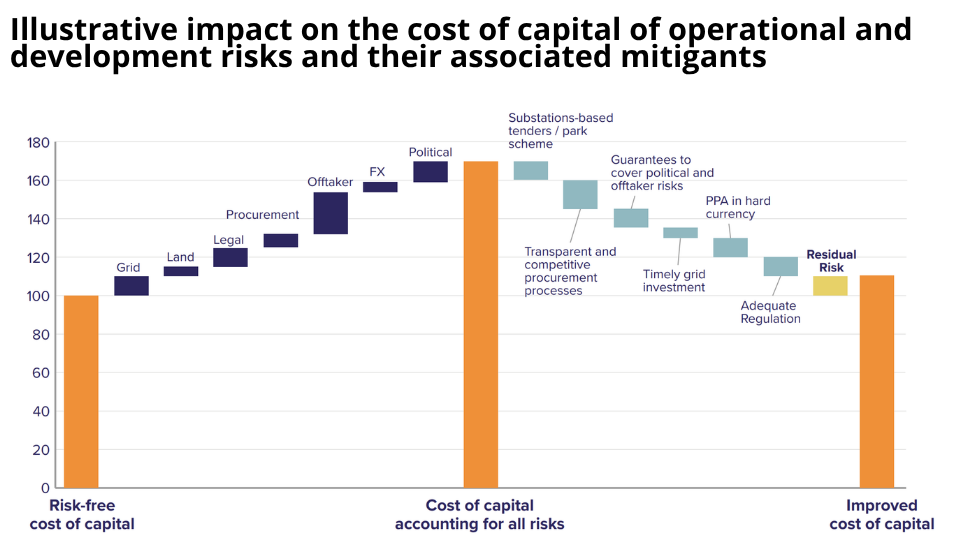
The primary constraint to renewable energy deployment is not a lack of capital, but rather a shortage of bankable projects. Private investors are willing to engage in well-structured, low-risk projects, even in challenging environments. However, many EMDC lack a consistent pipeline of such projects. Creating this pipeline requires coordinated government action to address country- and project-specific barriers that elevate risk and deter Independent Power Producers (IPPs).
Governments play a central role in delivering the energy transition while maintaining affordability and reducing poverty. With support from Multilateral Development Banks (MDBs) and other development partners, governments can establish enabling environments by adopting clear, long-term energy transition strategies, ensuring regulatory stability, and defining institutional roles that remain consistent across political cycles. A stable regulatory framework, allowing IPPs to own generation and grid assets and enabling competitive tenders, is critical to attracting private investment.
Transparent and competitive procurement processes further reduce risk, lower tariffs, and limit corruption. These processes must be grounded in sound legal frameworks and integrated with power system planning, including variable renewable energy (VRE) integration. At the same time, power sector reforms and project-specific risk mitigation measures are needed to address offtaker risk, a common challenge in EMDC, particularly where utilities lack creditworthiness.
Grid limitations and curtailment risks also pose major obstacles. Scaling renewable energy requires substantial grid expansion, modernization, and improved system planning, alongside clear allocation of curtailment risk in power purchase agreements. Foreign exchange risk remains another significant challenge, as reliance on international finance can expose utilities to currency volatility, underscoring the need to strengthen domestic lending markets.
Concessional finance and development partner support are essential to overcoming these barriers, not on a project-by-project basis, but to systematically reduce risks and build sustainable pipelines. By strategically deploying concessional funds, providing technical assistance, and developing innovative risk mitigation instruments, MDBs and development partners can help unlock private investment and lower the overall cost of the energy transition in EMDC.