












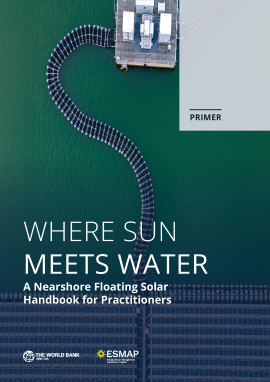
Where Sun Meets Water | A Nearshore Floating Solar Handbook for Practitioners
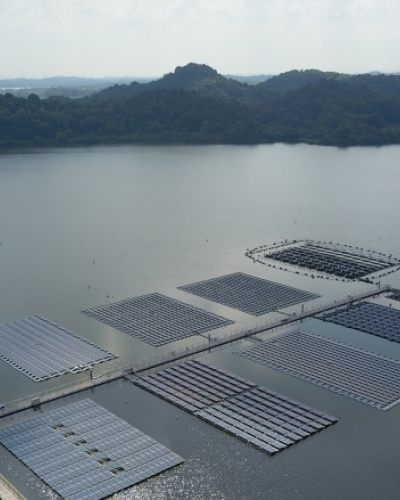
Nearshore floating photovoltaic (FPV) has the potential to expand renewable energy generation in land-constrained countries, particularly in island and archipelagic states, coastal cities, and industrial areas where suitable land and inland water resources are limited. This handbook, developed by the Energy Sector Management Assistance Program (ESMAP) of the World Bank, provides practical guidance for stakeholders involved in the planning and development of nearshore FPV projects, covering the project cycle from site identification and feasibility assessment through design, permitting, financing, procurement, construction, commissioning, and operations.
The handbook finds that nearshore FPV has progressed beyond the pilot stage and can be commercially viable at suitable sites, but remains an emerging technology with limited long-term operating experience. Compared with inland FPV, nearshore projects face additional technical, environmental, and financial risks associated with waves, currents, tides, salinity, corrosion, biofouling, and marine operations. Robust site selection is therefore critical and requires assessment of metocean conditions, bathymetry and seabed characteristics, environmental and social sensitivities, stakeholder interests, infrastructure, and grid access.
The analysis also highlights the importance of site-specific engineering, particularly for mooring and anchoring systems, structural design, material selection, and energy-yield assessment. In the absence of a comprehensive international design code for nearshore FPV, established offshore and coastal engineering standards can complement emerging FPV practices. Environmental and social considerations should be integrated throughout the project life cycle, given the ecological sensitivity of coastal environments and the diversity of affected stakeholders.
Overall, nearshore FPV represents a promising option for scaling renewable energy where land and inland water resources are constrained. Targeted public support, concessional financing, risk-mitigation instruments, and systematic monitoring can help address early-stage risks, build operational experience, improve bankability, and support responsible market development.